Computer Numerical Controls (CNC) Market How Will The Vendors Reduce The Operational Costs? 2017 - 2026
Computer Numerical Controls (CNC) Market: Snapshot
The growing demand for production efficiency is aiding the uptake of computer numerical controls (CNC) as these machines streamline various operational processes by reducing production time and minimizing human error. The highly competitive environment has compelled players to focus on efficient manufacturing techniques. They are also trying to gain competitive advantage by redesigning their manufacturing facilities to include CNC machines. The integration of 3D printing with CNC machines is one such addition to some of the new production units, which is expected to offer better product design with little to no resource wastage.
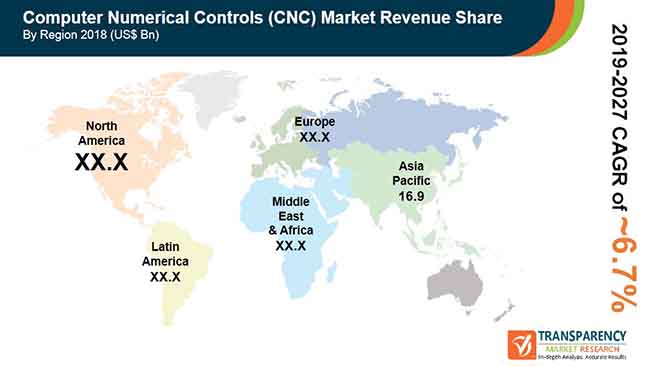
Fueled by these factors, the computer numerical controls Market is projected to grow from a value of US$ 64.0 bn in 2018 to US$ 115.1 bn by 2027. If these values hold true, the CNC market is expected to register a CAGR of 6.7% during the forecast period.
Custom Market Research Services - Request Customization -@
https://www.transparencymarketresearch.com/sample/sample.php?flag=CR&rep_id=2031
https://www.transparencymarketresearch.com/sample/sample.php?flag=CR&rep_id=2031
Automated Manufacturing Drives Demand for CNC in Industrial and Automotive Sectors
Based on type, the global computer numerical controls (CNC) market is led by lathe machines and the segment is poised to dominate the market throughout the forecast period. The demand for lathe machines can be attributed to a wide application area. On the other hand, milling machines are anticipated to register a strong growth rate during the forecast period. Milling machines are compatible with a wide range of materials and surfaces and help improve overall efficiency. Furthermore, technological innovation has led to the development of advanced milling machines that can provide a more consistent finish to the products.
In terms of application, the industrial segment held the dominant share and is likely to retain its lead through 2027. The growing demand for automated manufacturing in the industrial sector resulted in the increasing uptake of CNC machines. The establishment of manufacturing facilities in developing regions such as Asia Pacific has also spurred the usage of computer numerical controls in this sector. The automotive sector, on the other hand, is set to be the most rapidly developing segment in the coming years thanks to the soaring rate of automated automobile manufacturing.
Get More Press Releases by TMR:
Structured
Cabling Market to Rise at CAGR of 7.25% During (globenewswire.com)
North America Continues to Present Immense Scope despite Market Saturation
From a geographical viewpoint, the global market for computer numerical controls is led by Asia Pacific, with the region accounting for a share of approximately 35.0% in 2018. Developing economies such as China and India have been witnessing robust growth in terms of industrialization, thereby propelling the regional market. The automotive sector has been estimated to be register rapid growth in the Asia Pacific CNC market during the forecast period owing to the rising demand for automobiles in the region. In addition, the easy availability of labor and the declining prices of components have resulted in manufacturers shifting their production units in this region. This is further propelling the APAC computer numerical controls market
Considering that the U.S is the one of the earliest adapters of new technologies, the North America market for CNC machines is relatively saturated. Be that as it may, rising concerns over global warming and depleting energy reserves have led to the production of alternative sources of power such as solar, water, and wind, and this has significantly upped the demand for computer numerical controls in the region. CNC machines are actively used in power generation as the process requires wide-scale automation.
Buy now our premium research
report @
https://www.transparencymarketresearch.com/checkout.php?rep_id=2031<ype=S
Technological Advancements to Boost Global Computer Numerical Controls (CNC) Market
With the improvement in production technology, the time taken to manufacture components has decreased, and the ability to manufacture components with a better surface finish has increased. Due to a lack of available space, the market is being driven by the rising demand for smaller factory footprints. Modern machine variants are lightweight and do not necessitate continuous supervision of machine operations by a supervisor or an operator. As a result, the organization is able to save money by reducing the need for manual labor, which is likely to support growth of the global computer numerical controls (CNC) market in the near future.
About Us:
Transparency
Market Research is a global market intelligence company, providing global
business information reports and services. Our exclusive blend of quantitative
forecasting and trends analysis provides forward-looking insight for thousands
of decision makers. Our experienced team of Analysts, Researchers, and
Consultants, use proprietary data sources and various tools and techniques to
gather, and analyse information. Now
avail flexible Research Subscriptions, and access Research multi-format through
downloadable databooks, infographics, charts, interactive playbook for data
visualization and full reports through MarketNgage, the unified market intelligence
engine. Sign Up for
a 7 day free trial!
Contact
Rohit Bhisey
Transparency Market Research,
90 State Street, Suite 700,
Albany, NY 12207
Tel: +1-518-618-1030
USA – Canada Toll Free: 866-552-3453
Email: sales@transparencymarketresearch.com
Website: https://www.transparencymarketresearch.com/


Comments
Post a Comment